Work of Fine Art From the Classical Period Example
Classic art styles from the aboriginal Greco-Roman periods have influenced the works of artists for centuries. What is it most the art from these periods that continues to inspire artists from Leonardo da Vinci to Banksy? Classical notions of proportion, balance, harmony, and elegance subtly permeate the sculptures, architecture, and paintings of many modern art movements. In this commodity, we are going to have a deep dive into the fundamentals of Classical art and explore its continued influence.
Tabular array of Contents
- 1 A Broad Overview of the Classical Aesthetic
- two Key Stylistic Contributions From Ancient Greece
- 2.i 1600-1100 BCE: Early Mycenaean Influences
- 2.2 776-480 BCE: Greek Archaic Period
- 2.3 480-323 BCE: Classical Greece
- 2.4 323-31 BCE: The Age of Hellenistic Greece
- iii Primal Stylistic Contributions From the Roman Empire
- 3.one 509 BCE-26 CE: The Roman Republic
- 3.2 27BCE-393 CE: The Regal Roman Empire
- iv Long Live Classicism
- 4.1 The Italian Renaissance: Classicism Art Revival
- 4.2 Neoclassicism: Reinventing Classical Ideas
A Wide Overview of the Classical Aesthetic
The Classicism definition of art and architecture from the Greco-Roman eras emphasizes the qualities of balance, harmony, idealization, and sense of proportion. The human form was a common subject of Classical art and was always presented every bit a generalized and idealistic figure with no emotionality. The composition and line in Classical styles are far more than of import than the utilize of colour.
Classical architecture is underlain by Classical concepts of mathematically precise proportions that create residual and symmetry. The eras of Greek and Roman Classicism saw a monumental level of architectural innovation, from the invention of cement to the use of the dome. Elements of Classical compages continue to permeate Western theories and practices today.
Before we can investigate the influence of Classicism artists throughout the ages, information technology is essential to sympathise how the elements of the Classicism definition adult. The mode spans centuries, cultures, and continents. Nosotros begin with the earliest utterances of the Classical style in Mycenaean Greece and stop in the Imperial Roman Empire.
Central Stylistic Contributions From Aboriginal Greece
Aboriginal Greece is the starting point in our journeying through Classicism. We tin see the spark of Classicism in the vase paintings of the early on Mycenaeans and the development of the gilt ratio. First, we look at the historical development of Aboriginal Greek culture, and and then we will look closer at some of the most of import contributions to Classicism.
1600-1100 BCE: Early Mycenaean Influences
The Mycenaean civilization is considered the starting time Greeks, and their style of art, sculpture, and compages were fundamental building blocks for later Greek Classicism. Geographically, this elite warrior civilization spanned the coastal areas of modern-solar day Italia, Turkey, Syria, and Southern Greece.
Mycenaean social club was governed by palace states and can be separated into three classes: slaves, common people, and attendants of the king. The king of each palace country wielded religious, political, and military authorization. Heroic warriors and gods were worshiped by the Mycenaean people and early Mycenaean art often pay homage to these figures. The tales of these gods and warriors lived on in later Greek literature, like the Odyssey by Homer.
The drivers of Mycenaean geographical and political expansion were trade and agriculture. The Mycenaean engineering genius enhanced both of these drivers with drainage systems, dams, harbors, bridges, aqueducts, and a road network only rivaled by the Romans. Cyclopean masonry created enormous fortifications from large boulders held together with mortar.
These innovative architects created the relieving triangle, a common practice today whereby a triangular infinite is left above the lintel to keep stone archways from collapsing.
Mycenaean societies were the first to create the acropolis loma-summit fortress that came to characterize after Greek towns. The center of the king's palace was a circular throne room oftentimes decorated with vibrant frescos. These frescos depicted goddesses and gods, battle scenes, the ocean, hunting parties, and symbolic processions. Following the Mycenaean era of prosperity, the Greek Dark Ages saw the Geometric style of vase painting.
Vase Painting
Although vase painting continued throughout the following periods of Ancient Greek history, it has its roots in the Mycenaean era. The vase painting of Classicism artists exemplifies the Ancient Greek focus on portraying the human being form in an increasingly realistic manner.
Geometric patterns adorn the earliest vase paintings, but the focus quickly shifted to the man effigy. Following this, vase painting became more than oriental, depicting Eastern motifs. The black-figure style followed, using black to present more accurate and detailed human figures.
Some other mode of vase painting arose during the Classical Greek era using crimson rather than black figures. Vase painters in this style crafted human figures with strong outlines on black backgrounds. This technique immune artists to paint the fine details rather than incising them into the clay. The resulting color and line variations are more rounded than the patterns from the Geometric era.
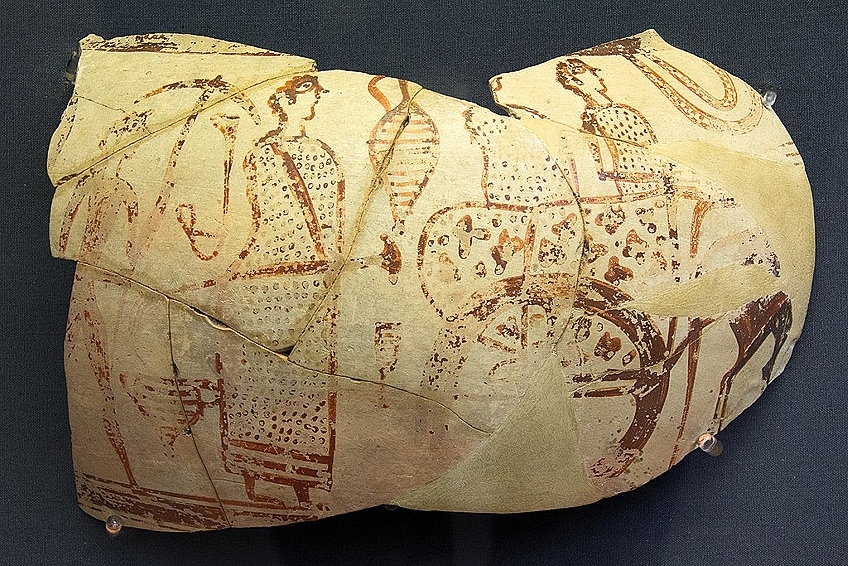 Mycenaean pottery fragment of a krater showing a chariot with charioteer and rider and ii figures walking backside, 1400-1350 BC. Establish in Tobm 67, Enkomi, Cyprus; Zde, CC Past-SA 4.0, via Wikimedia Commons
776-480 BCE: Greek Archaic Menses
The establishment of the kickoff Olympic Games marked the beginning of the Greek Archaic menstruum. For this Greek civilization, human achievement as personified by the able-bodied games set them apart from "barbarian" people not of Greek descent. The Mycenaean era was valorized by the Archaic Greeks, leading to the idealization of the male course.
For the Greeks of this period, the nude male figure represented the epitome of bodily dazzler and character dignity. It stands to reason that the male person form featured heavily in the Classical art of this Greek period.
The Greek Archaic period also saw meaning shifts in social and political life. The political and social arrangement of the Archaic Greeks was based on the city-state. Sparta was a city with immense military ability, while Athens became the center of western art, philosophy, science, and civilization. Around 594 BCE, a philosopher male monarch, Solon, created a political body that could challenge the king and fundamentally shift the political landscape of the day.
People were no longer placed into slavery for debt, and the ruling class was established based on wealth, not descent. Extensive ocean-based trade drove the Greek economy, and many urban center-states began establishing settlements across the Mediterranean. Equally a result, Greek cultural, artistic, and political ideals spread to other European cultures like the southern Italian Etruscans.
The about significant creative innovation of this catamenia in Greek history was figurative sculpture. These idealized yet realistic sculptures took influence from Egyptian sculpture and the idealization of the nude male form. The Cyclades islands were the birthplace of the beginning life-sized sculptures of young women (kore) and men (kouros). Towards the end of the Primitive era, sculptors similar Nesiotes, Kritios, and Antenor rose to fame.
In 510 BCE, Antenor created the bronze Tyrannicides in commemoration of Aristogeion and Harmonides, the 2 assassins of Hipparchos. These two men symbolized the transition towards democracy. The significance of this sculpture lies in the fact that it was the get-go recorded piece of publically funded fine art. The sculptor, Kritos, recreated the sculpture in the Early Classical style with private characterization and realistic move, following its disappearance when the Persians invaded.
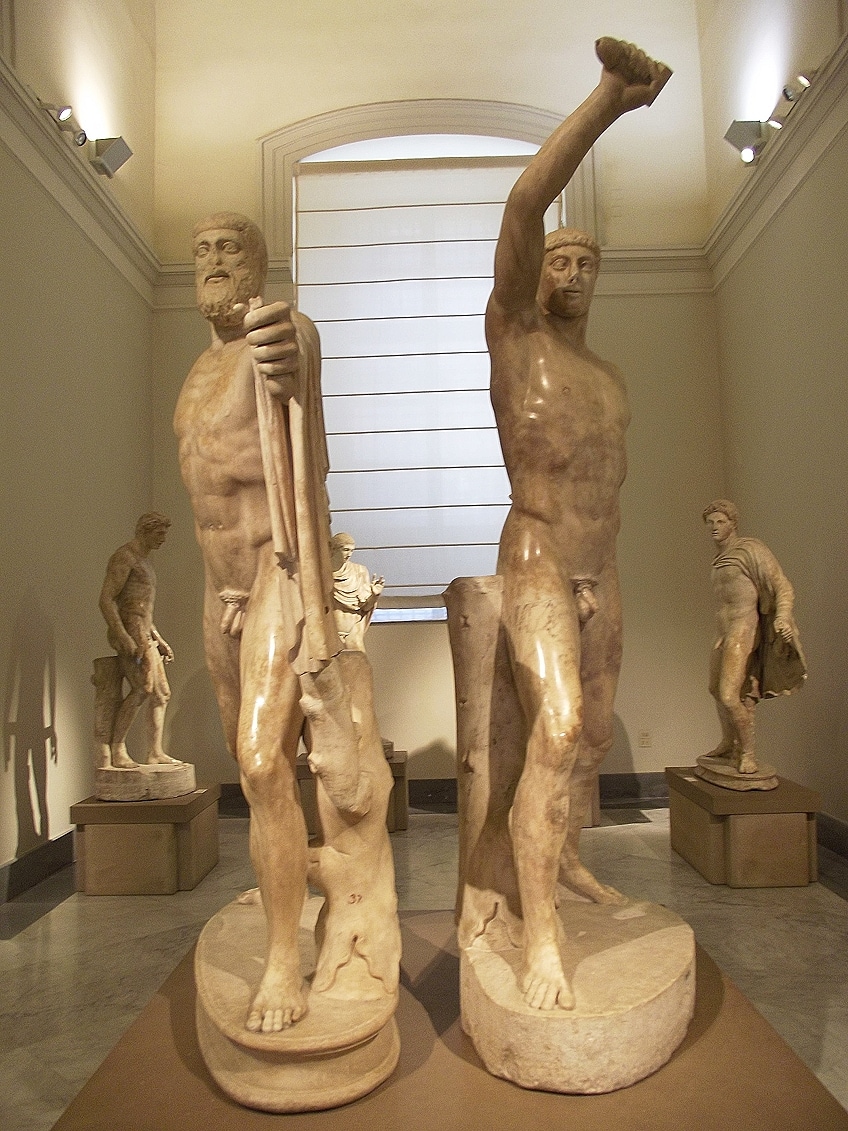 Tyrannicides(510 BCE) by Antenor; Elliott Brownish, CC BY two.0, via Wikimedia Commons
Greek Classicism Sculpture: Molding the Classical Style of Sculpture
Ancient Egyptian sculpture was very influential to Greek sculptors from the Archaic period. Greek sculptors created life-sized sculptures of kouroi. At that place are three distinct types of kouroi: the standing and dressed young adult female, the nude young man, and the seated woman.
Funerary monuments, votive statues, and public memorials featured the characteristic "Primitive grinning". The sculpted representations of the human effigy were more idealistic than realistic and were rarely of individuals. Archaic Greek sculpture captures human movement through realistic anatomy.
The tardily Archaic era saw the celebrity of sculptors like Kritios, Phidias, Myron, Lysippus, and Scopus, to proper noun a few. Discobolus, a sculpture by Myron, became famed for being the offset sculpture to capture the balance and harmony of human being movement in a moment. Classic Greek sculpture, as with painting and architecture, became increasingly focused on mathematically precise beauty. Polycleitus's systems of mathematical proportions focus on creating rhythm and residual through symmetry.
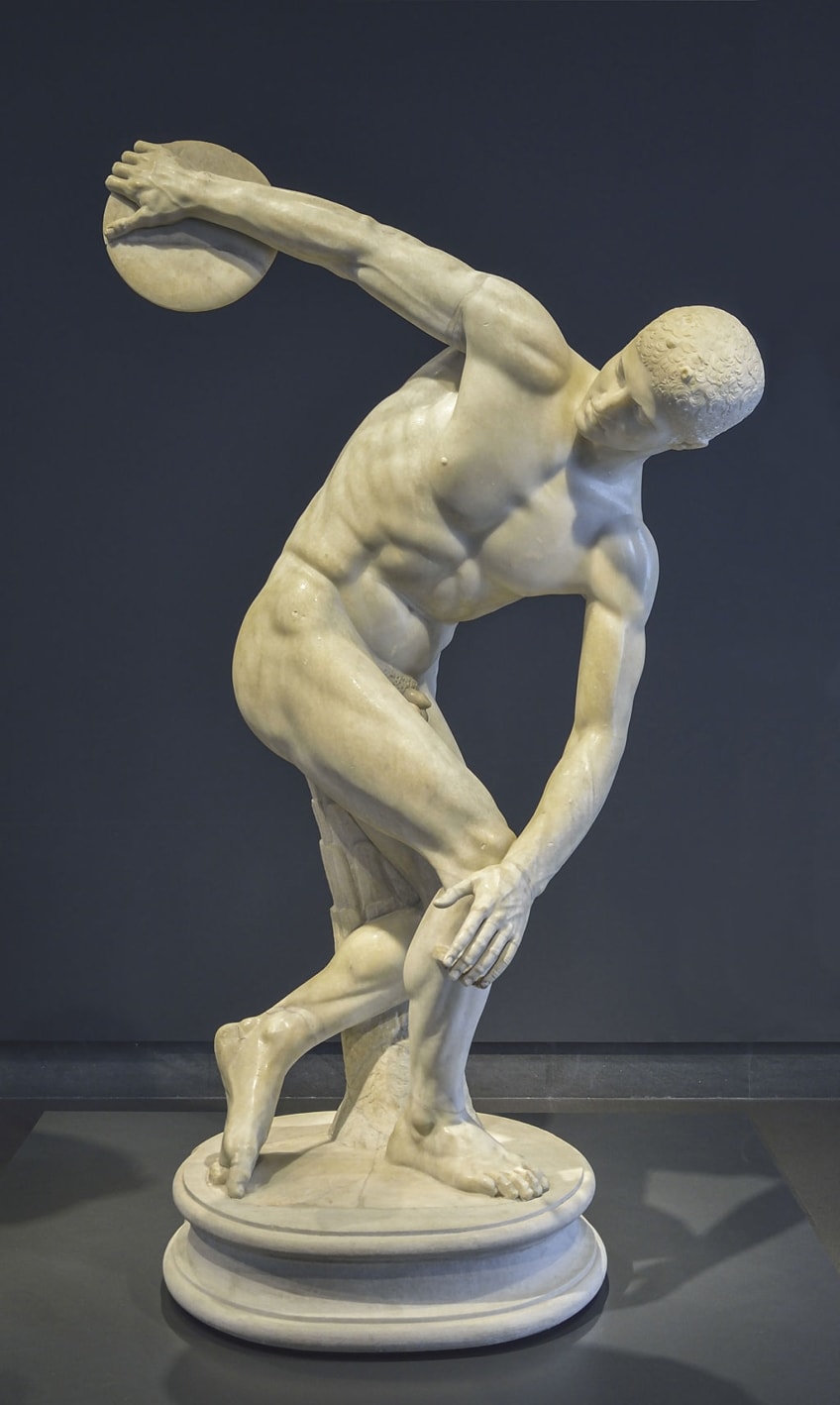 Discobolus (c. 140 Advertizement) in National Roman Museum Palazzo Massimo alle Terme; After Myron, CC Past-SA 4.0, via Wikimedia Commons
Early Greek bronze sculptures were created using hammered sheets held together with rivets. Techniques became more advanced by the end of the Archaic catamenia. Greek sculptors started to use the lost wax method of bronze sculpture. Large-scale sculptures were created past casting the bronze in several pieces. These pieces would so be welded together, and the teeth, eyes, fingernails, lips, and nipples were formed from copper inlays.
Unfortunately, a big number of the original Greek statuary statues do not exist today. The early Christian era melted down several statues believed to represent pagan idols. Of those that remain, the Raice bronzes, the Charioteer of Delphi, and the Artemision Bronze are notable examples.
As well as three-dimensional sculptures, Greek sculptors decorated temple entablatures with relief sculptures depicting mythological scenes and legendary battles. The Parthenon Marbles, created by Phidias, are perhaps the well-nigh famous examples of this style of Classical Greek sculpture. These relief sculptures are known for their dynamic movement and realism and decorated the temple chamber's interior walls. This sculpture, and other reliefs of this time, have influenced afterward artists similar Auguste Rodin.
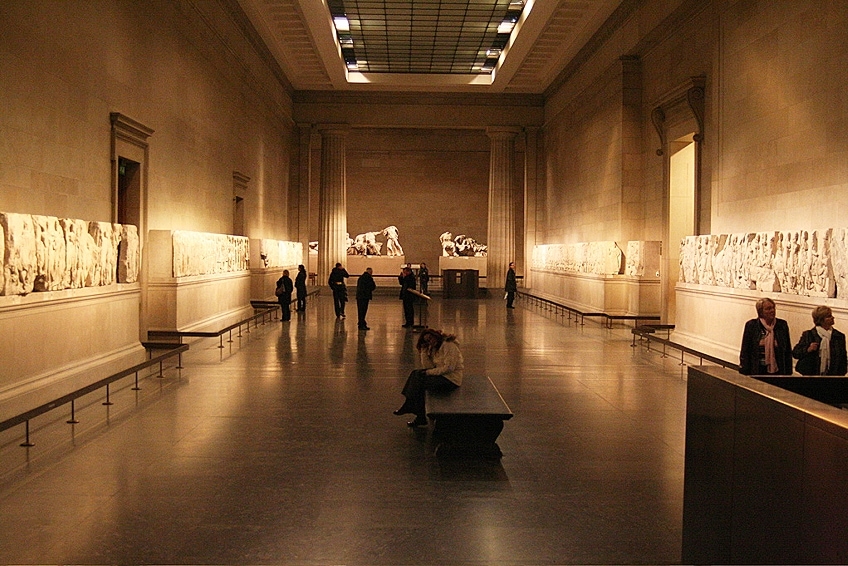 Parthenon marbles in the British Museum; Discobolus in National Roman Museum Palazzo Massimo alle Terme Nic McPhee from Morris, Minnesota, United states of america, CC By-SA 2.0, via Wikimedia Commons
Chryselephantine statues in gilt and ivory were a popular form of Classicism sculpture during the early Archaic period. Phidias worked in these mediums, creating the 43-foot-alpine Statue of Zeus at Olympia (435 BCE) and the about 40-human foot-tall Athena Parthenos (447 BCE). A wooden construction is a basis for both of these statues, and ivory limbs and gold panels are attached in a segmental style. These impressive statues stood non but as an expression of Aboriginal Greek power and wealth, but too equally symbols of the gods.
Unfortunately, neither of these sculptures are standing today. What nosotros know of them comes from descriptions and representations on coins.
480-323 BCE: Classical Greece
Besides known as the Golden Historic period, the philosophy, art, scientific discipline, politics, and architecture of the Classical Greek menstruum were fundamentally influential for the developing Western civilization and the Roman Empire. Western philosophy has its roots in the writings of Aristotle, Plato, and Socrates. Although central aspects of their philosophy diverged, Aristotle and Plato agreed that fine art should aspire to recreate the beauty of the natural globe.
Freedom of speech and the assembly of a Greek authorities of citizens divers a new age of Greek democracy. Sculptor Phidias and Pericles rebuilt the Parthenon in Athens. The power and cultural influence of Athens increased and spread throughout the Mediterranean.
With the growing emphasis on the private in Classic Greek society came an increase in personalized art. Sculpture for funerals became increasingly realistic in emotional expression, as opposed to the idealization of the past. The nude male form continued to be celebrated in bronze sculpture. The female grade too began to become attention, as seen in Praxiteles' Aphrodite of Knidos.
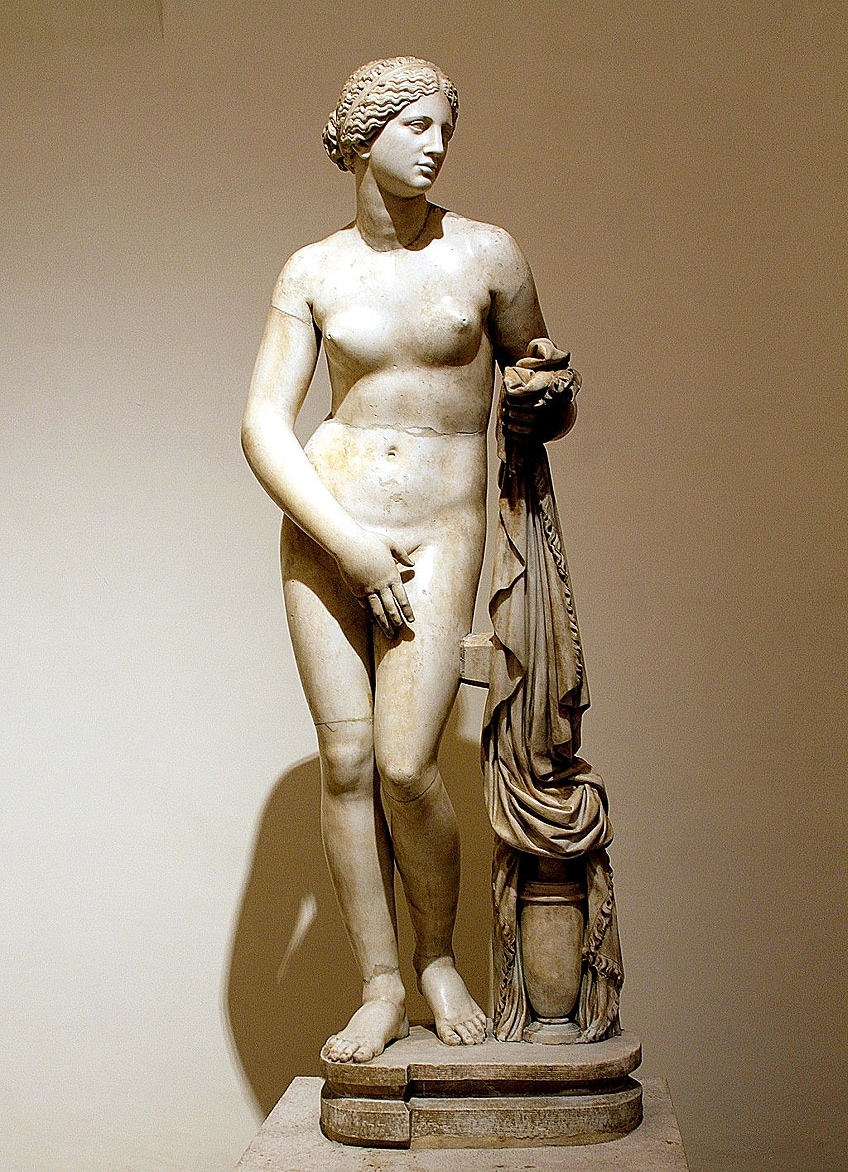 Aphrodite of Knidos (c. 4th century BC) by Praxiteles of Athens; José Luiz Bernardes Ribeiro, CC By 4.0, via Wikimedia Commons
The Gilt Ratio: The Beauty Proportion
For Ancient Greek philosophers and artists alike, there was a close association between dazzler and truth. Equally the Aboriginal Greeks did, nosotros tin sympathize dazzler and truth in mathematical terms. Aristotle's golden mean represented the fashion to alive a life of virtuous heroism by fugitive any extremes. For Socrates, all areas of virtue and beauty were manifestations of proportion and measurement.
Pythagoras and Euclid developed the golden ratio based on ii quantities and the proportion between them. The ratio between these two measurements should be equal to the ratio between the larger measurement and the sum of the two measurements.
A substantial amount of Aboriginal Greek architecture employed the golden ratio, with possibly the nearly well-known being the Parthenon. Phidias oversaw the edifice of the Parthenon. Today, the golden ratio is known past the Greek alphabetic character phi to award Phidias' contribution to the most perfect building imaginable.
For many Archetype artists and architects, the golden ratio has remained an integral concept. Vitruvius, the Roman architect, used the aureate ratio, and his principles had a profound effect on the art and architecture of the Renaissance period. Even mod architects similar Le Corbusier find inspiration in the aureate ratio.
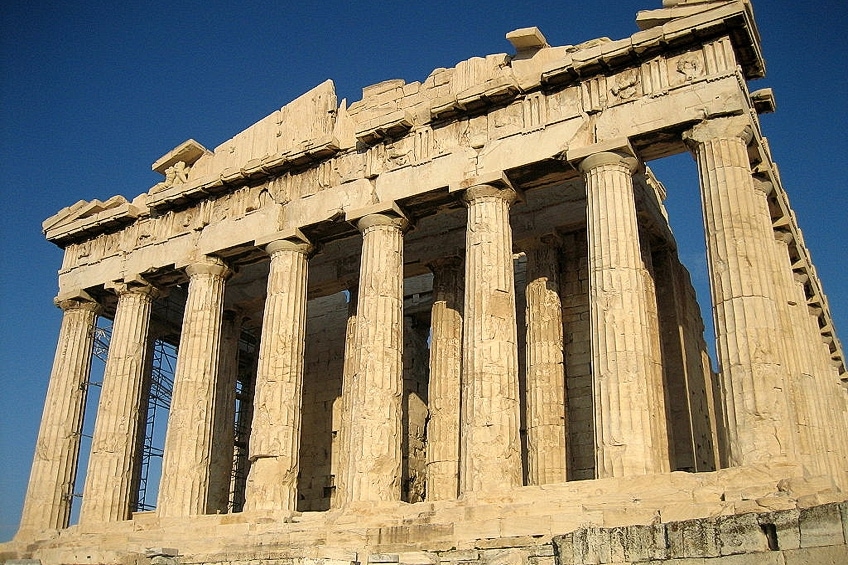 The Parthenon from the west; User:Mountain, Public domain, via Wikimedia Commons
323-31 BCE: The Age of Hellenistic Greece
The Hellenistic era in Hellenic republic started with the decease of Alexander the Great. Following his death, a political scramble left the Greek empire divided into three separate states. The influence of mainland Greek culture was in a gradual decline, while Hellenistic culture flourished in Egyptian Alexandria and Syrian Antioch. The immense wealth that remained in these epochs of the Greek empire led to the arts having royal patronage. Compages, sculpture, and painting, in particular, flourished with backing from the royal courts.
Lysippus was the official sculptor for Alexander the Great, and post-obit Alexander'due south decease, crafted statuary sculptures that mark the transition from Classical to Hellenistic styles. Some of the most well-known artworks from Aboriginal Hellenic republic were created during the Hellenistic period.
Much of the art from the Hellenistic era had functional purposes. Early Hellenistic sculptures were often, get-go and foremost, votive gifts and architecture focused on civil monuments with social value. Artistic value for Hellenistic artists came second to function.
Information technology was during the Hellenistic era that great strides in Greek architectural design took place. With a focus on urban planning, Hellenistic architects designed theaters, parks, and buildings for other recreational activities. The Corinthian society is possibly the most decorative Classic society and is exemplified in the jumbo temples of the time.
The metropolis of Pergamon, known for its enormous architectural complexes, became a cultural epicenter of the Hellenistic period. A stunning example of Hellenistic architecture is the Pergamon Altar. It was during the Hellenistic era that Greece became slowly integrated into the Roman Empire.
Ancient Greek Architecture: Laying the Foundations
Ancient Greek architecture is mayhap best known for its temples that embody the cultural accent on formal unity. The temples were often rectangular and framed by open up colonnades. Ancient Greek architects developed 3 orders of Classic architecture: the Corinthian, the Ionic, and the Doric. These orders set the foundations for Roman architecture, and the concepts spread throughout Europe and America.
Each order stemmed from singled-out places and times in Ancient Greece. It is possible to distinguish between the architectural orders based on the capitals, the columns, and the entablature. The Doric order uses circular capitals, fluted or smooth columns, and entablature features that add a more elaborate and embellishing element to the unproblematic design.
The use of scrolls or volutes to accent the top of the capital is typical of the Ionic order. Narrative frescos extend beyond the length of Ionic buildings every bit a consequence of the entablature design. The Corinthian society is a later Classical architectural design named after the city of Corinth. Corinthian architecture is by far the virtually elaborate, with acanthus leaf motifs and decoratively carved capitals.
The starting time Aboriginal Greek temples were constructed from forest using a post and beam blueprint. Rock and marble became increasingly popular, and the Parthenon was the first temple to be synthetic entirely from marble. Aboriginal Greek architects were pioneers of the amphitheater and the stadium. The Romans afterward appropriated these architectural structures.
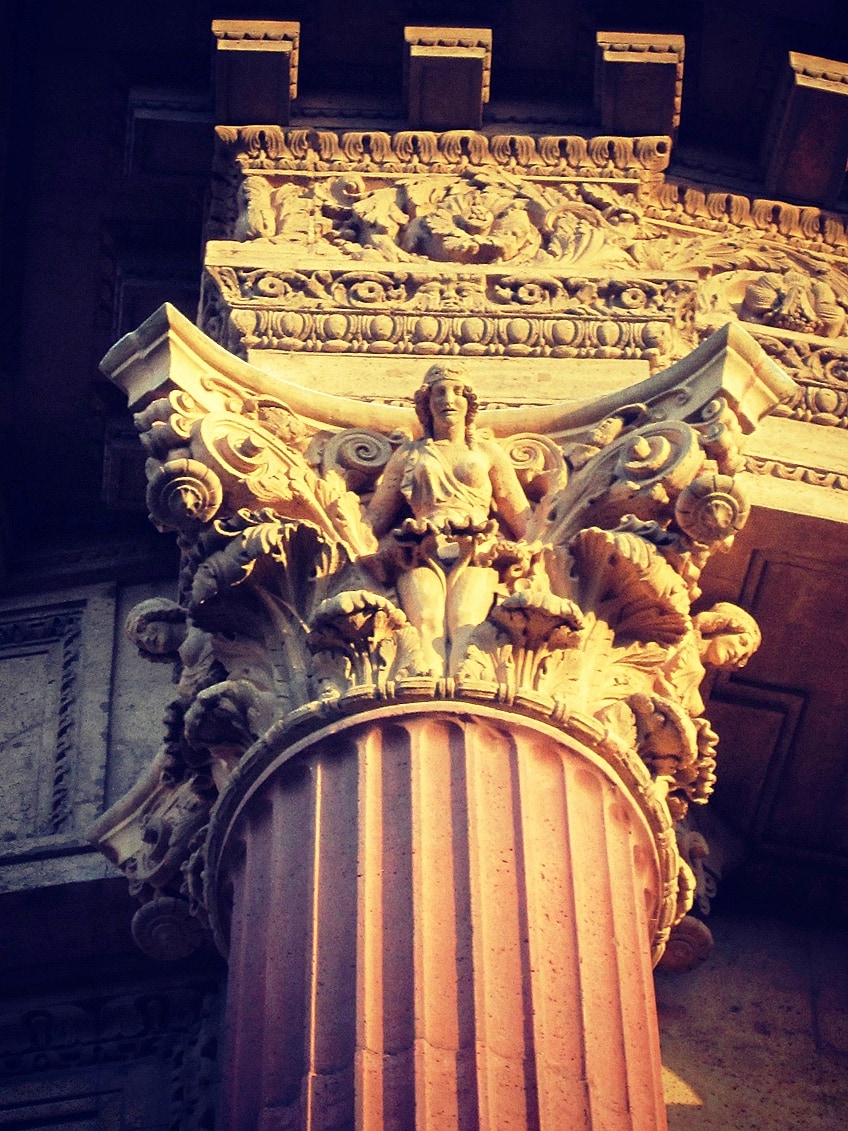 A Corinthian Society capital; Amanda Sidell, CC BY-SA 4.0, via Wikimedia Eatables
Frescos: A Bridge Betwixt Aboriginal Greek and Roman Classicism Flow fine art
Although architecture and sculpture are the virtually common forms of Classical art, Greek and Roman painters made classical innovations in panel and fresco painting. Most of what we know about Classical Greek painting comes from the painted vases and Roman and Etruscan murals influenced by the Greeks. One stunning example of Classic Greek frescos is the landscape Hades Abducting Persephone in the Vergina tombs. This mural reflects the increased realism of Greek paintings and sculptures of this time.
A peachy deal more Roman fresco and panel paintings survive. The excavation of Pompeii in 1748 revealed several very well-preserved Roman frescos in residences like the House of the Vettii, the House of the Tragic Poet, and the Villa of Mysteries. These fresco paintings brought a sense of color, lite, and space into interiors that were often nighttime, cramped, and lacked windows.
Pop fresco subjects included scenes from the Trojan state of war, religious rituals, landscapes, mythological tales, notwithstanding lifes, and erotic scenes. Often walls would be painted to resemble alabaster panels or brightly colored marble, often enhanced by illusionary cornices or beams.
Key Stylistic Contributions From the Roman Empire
In the Roman Classicism menstruum, art took a great deal of inspiration from the artistic and cultural developments of Ancient Greece. Building on the Greek valorization of heroic figures and grand architecture, the Romans build cities, deputed public art, and developed Classical portraiture.
509 BCE-26 CE: The Roman Commonwealth
The Roman Senate, a collection of noblemen, elected the kings in the Roman Democracy, which began as an immense metropolis-country. Rome became a Republic following the expulsion of the final King, Lucius Tarquinii Superbus, in 509 BCE. Tarquinii was deposed past the husband and father of a noblewoman raped past his son. Not just was this story central to the History of the Roman Commonwealth, but it was also a central subject of Roman art in the centuries that followed.
Following the abolitionism of kingship, the Roman Commonwealth established a new governing system led by ii consuls. The governing upper course and the common people were often in conflict, and this situation inspired much of the architecture in early Rome. City planning on a filigree system emphasized public amusement facilities to go on the peace. In the tertiary century, the Romans developed concrete revolutionizing engineering and architecture.
Many of the Greek stories of heroes and gods were adopted by Roman culture, alongside their way of the ancestors' traditions. This tradition was an almost contractual relationship between Rome'due south founding fathers and the gods. Greek sculptures taken during the war were frequently displayed in Roman homes, public places, and palaces on the basis of their artful value.
The Greek Classical traditions discussed in a higher place were the master influence on Roman compages and art.
The Physical Revolution: Classical Advances in Roman Architecture and Technology
The Romans took architectural advancement to new levels. Technological innovations, including the invention of concrete, meant that architectural design was no longer limited to bricks and mortar. The dome, butt vault, arch, and groin vault were Roman architectural innovations.
The Roman era saw an age of incredible architecture, non only for pleasure like the Colosseum, merely also to improve urban center life like aqueducts, bridges, and apartment buildings. The arch is one of the most influential architectural developments from Roman Classicism. The segmental arch was pioneered for utilise in bridges and homes, while the triumphal and extended arches historic the emperor'southward victories.
The use of the dome is by far the most meaning innovation of Classical Roman compages. Roman architects were influenced by Greek architectural styles and the Etruscan utilize of hydraulic technologies and arches. Fifty-fifty when porticos, columns, and entablatures were no longer needed for structural integrity thanks to technological advancements, the Romans still used them.
Vitruvius is the most famous Roman architect and engineer. Between 30 and fifteen BCE, while working for the military of Augustus, Vitruvius wrote the Ten Books on Compages. These books are a tape of Roman architectural theory and practise, describing the process of town planning, religious building, different edifice materials, aqueducts and water supplies, and various types of Roman machinery like cranes and hoists.
The Vitruvian Triad refers to Vitruvian'due south theory that any built structure should have the qualities of beauty, stability, and unity. The Vitruvian architecture reflects the proportionate beauty of the natural earth and the human class. The extension of Vitruvian proportion to the man effigy is reflected in Vitruvian Human being (1490) past Leonardo da Vinci.
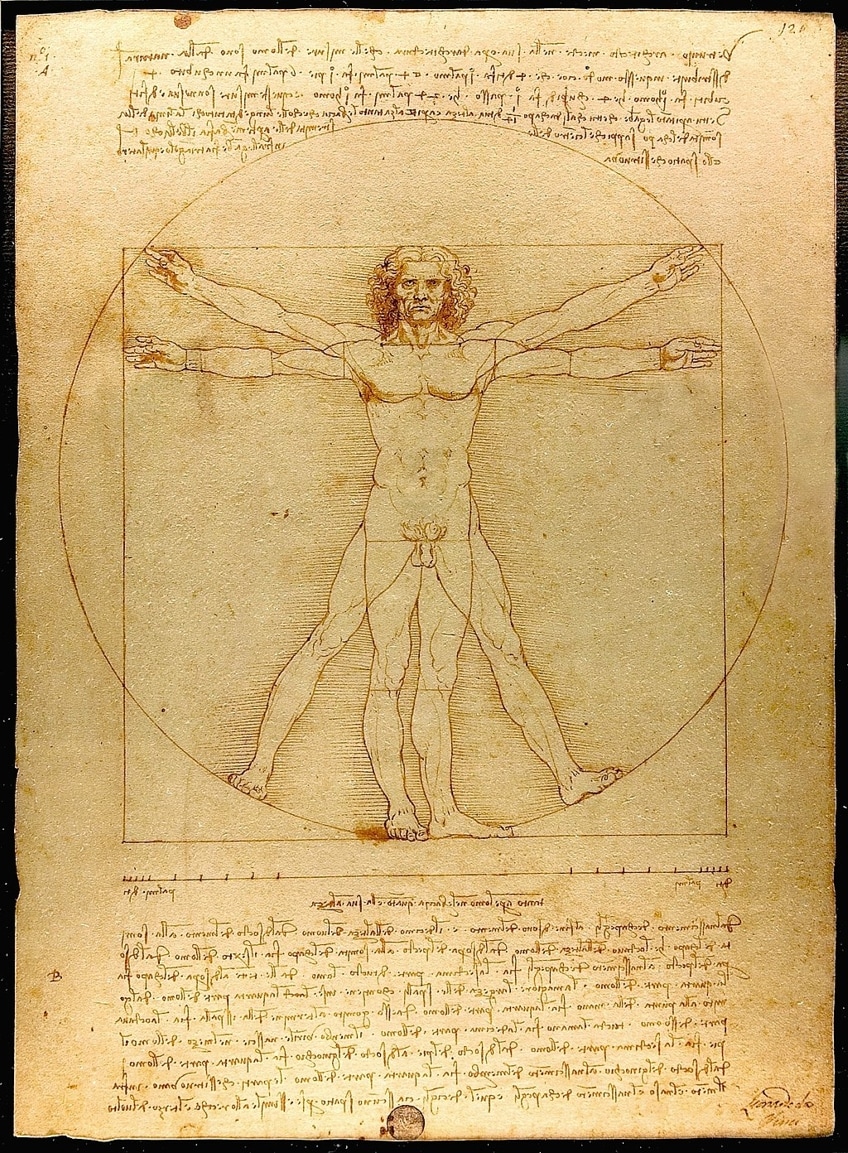 Vitruvian Human (1492) past Leonardo da Vinci; Leonardo da Vinci, Public domain, via Wikimedia Eatables
27BCE-393 CE: The Imperial Roman Empire
Despite the ceremonious state of war that followed Caeser's attempt to get emperor, Augustus eventually became the first emperor of Imperial Rome. Augustus reigned for most 45 years, and during this time, he created the first police force forcefulness, postal arrangement, fire fighting force, and municipal offices. The taxation and revenue systems implemented past Augustus immune him to transform the arts and launch a new programme of building temples and public buildings.
Artistic works similar Augustus of Prima Porta were deputed and played into the Classical Greek way of idealized representation. The lavish fine art of Regal Rome defined this flow. Yard architectural buildings were decorated with extravagant frescos and deputed portraits of the wealthy.
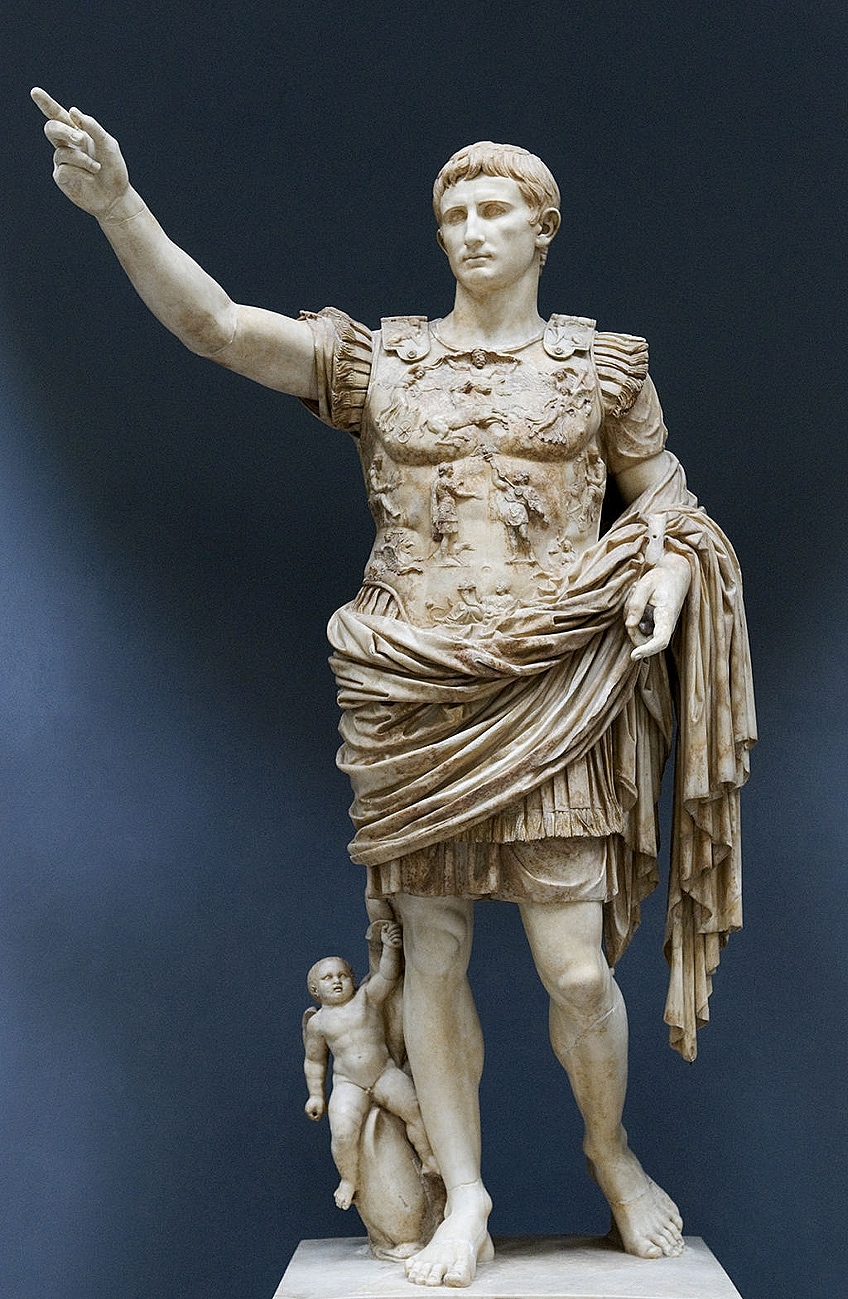 Augustus of Prima Porta, 1863; Michal Osmenda from Brussels, Belgium, CC Past-SA 2.0, via Wikimedia Commons
Roman Portraiture: Contributions to Classicism
While many Archetype Roman sculptures are petty more than copies of Archetype Greek sculptures, portraiture is where Roman innovation came into its ain. These early Archetype portraits emphasized realism. Early Romans felt that representing a powerful man in the most honest way possible was a sign of character.
The tables turned once emperors were reinstated during Imperial Rome. Portraiture in Majestic Rome was idealistic, producing strong politically motivated images presenting the emperors equally descendants of heroic Greek and Roman history. This practice led to the development of a Greco-Roman manner of relief sculpture.
Roman portraiture as well constitute inspiration in a Greek method of glass painting. Small portraits on medallion-sized pieces of glass or roundels from drinking glasses were popular. Personalized drinking cups containing gold glass portraits were popular among the nigh wealthy Romans and post-obit their decease, these glass portraits would exist cut into a medallion shape and placed into the cement walls of the tomb.
Amongst the nigh famous Roman portraits are those found on mummified bodies in Fayum. This fix of portrait panels was preserved past the dry out Egyptian climate and is the largest surviving collection of Classic Roman era portraiture. These portraits brandish an intermingling of Aboriginal Egyptian and Classical Roman traditions while Arab republic of egypt was under Roman rule. The way of these portraits is quite idealistic but the features of each individual are naturalistic and singled-out.
Long Live Classicism
The Legacy of Classicism did not autumn with the Roman Empire. The influence of Classical Greek and Roman architecture and art permeates all art periods and movements in the Western earth. Greek fine art and Roman architecture were influential for the Byzantine and Romanesque periods.
Information technology was the Italian Renaissance that really took inspiration from the Classical style of Greek and Roman art and architecture. The architectural exercise and theory of architects similar Palladio and Leon Battista Alberti are informed past Vitruvius' writings, the Pantheon, and the Parthenon.
The Italian Renaissance: Classicism Art Revival
The Italian Renaissance menstruum in the 15th and 16th centuries is perhaps ane of the more durable revivals of Greco-Roman Classicist art. Transitioning from the dark ages of art and culture, European artists, philosophers, and humanists renewed their involvement in Classical antiquity. Like Greco-Roman Classicism, the Italian Renaissance menses is hailed for its achievements in literature, compages, painting, philosophy, engineering, sculpture, and scientific discipline.
As nosotros have explored in Greek and Roman fine art and compages, proportion, beauty, and orderliness were central elements of Italian Renaissance Classicism art. The golden rectangle proportion associated with Roman and Greek architecture institute a revival in Renaissance architectural models. Renaissance artists like Albrecht Durer, Raphael, Michelangelo, and Leonardo da Vinci were influenced past Greek sculpture, every bit were later artists from the Baroque menstruation like Bernini. Below, you tin can see the gilded ratio's proportions displayed in da Vinci's famousMona Lisa painting.
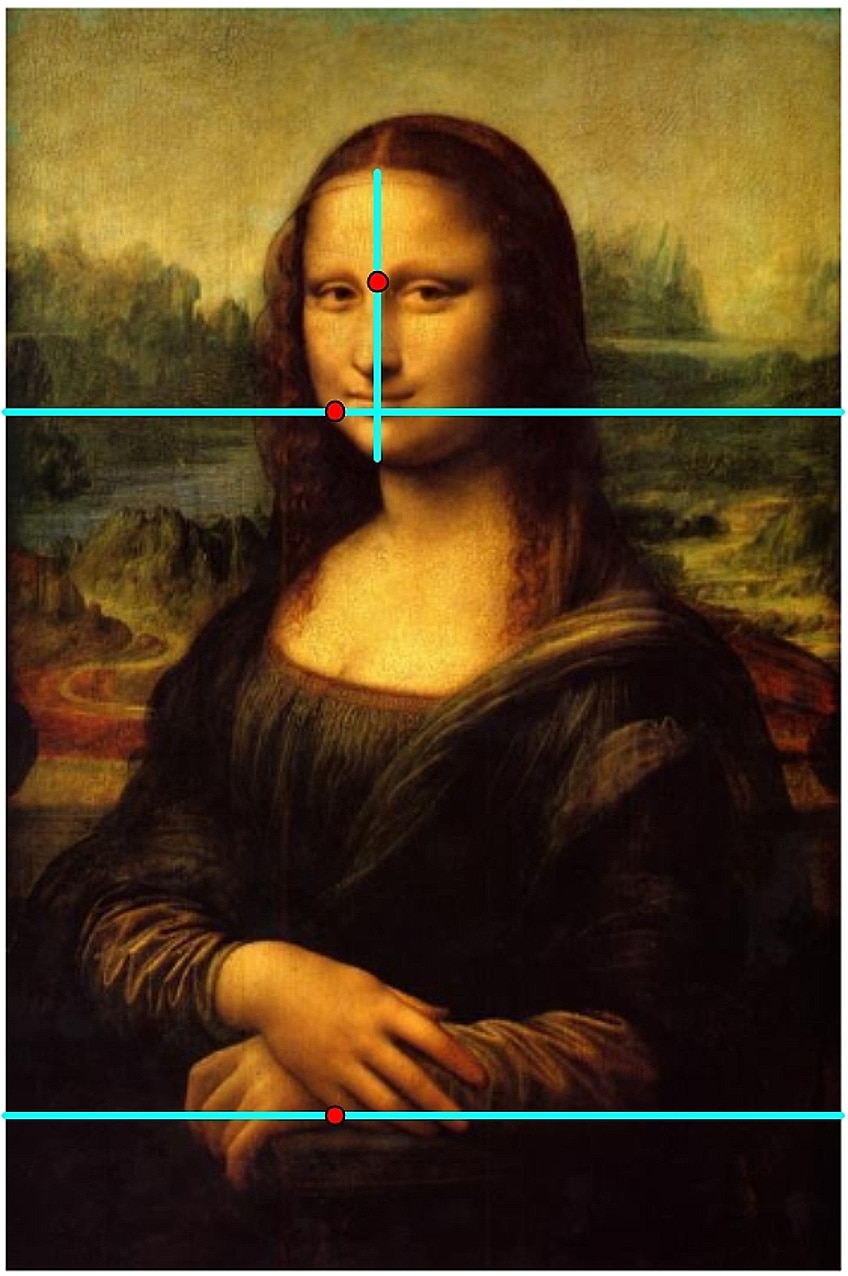 The golden ratio in Leonardo da Vinci's Mona Lisa (1503); Mabit1, CC BY-SA 4.0, via Wikimedia Commons
Neoclassicism: Reinventing Classical Ideas
The terms Classicism and Neoclassicism are often confused because of their similarity. While Classicism denotes the particular artistic, architectural, and philosophical aesthetic of the Aboriginal Greeks and Romans, Neoclassicism reflects whatever later imitation of these Classical styles.
Neoclassicism broadly refers to the manner of Classical false, just it besides refers more than specifically to an artistic movement in Western Europe during the 18th century. This art motion began in Rome, following the discovery of Pompeii. Soon, Neoclassical aesthetics based on Roman and Greek ideas spread throughout Europe.
The Neoclassical art motion occurred in parallel to the Age of Enlightenment during the 18th century and continued into the 19th century. In terms of architecture, Neoclassical aesthetics take continued to exist influential in the 21st century. The Neoclassical architectural fashion emphasizes symmetry and simplicity, tokens from Rome and Aboriginal Greece, and taken directly from Renaissance styles.
The Neo in Neoclassicism points to the difference between this fashion and its Greco-Roman inspiration. Neoclassical artists, writers, and sculptors chose some models and styles from Classicist art and ignored others. For example, Neoclassical artists paid homage to the sculptural ideas from Phidias' generation, but the sculptures that were actually produced are more than similar to the Roman remakes of Hellenistic sculptures. Drawings and engravings that reconstructed Greek buildings mediated the Neoclassical impressions of Greek architecture. Neoclassical artists entirely ignored artistic and architectural styles from Primitive Hellenic republic.
Although the roots of Classicism experience as though they are in the afar past, the aesthetic ideas continue to permeate many aspects of modern Western life. From architectural designs using cement and arches to the fundamentals of cartoon the homo figure and influential works of literature, Greco-Roman Classicism is all effectually usa. The Renaissance and Neoclassical celebration of Classical aesthetics is a testament to the innovation of early Greek and Roman artists and architects.
Have a look at our Classical Art menstruum webstory here!
Source: https://artincontext.org/classical-art/
0 Response to "Work of Fine Art From the Classical Period Example"
Post a Comment